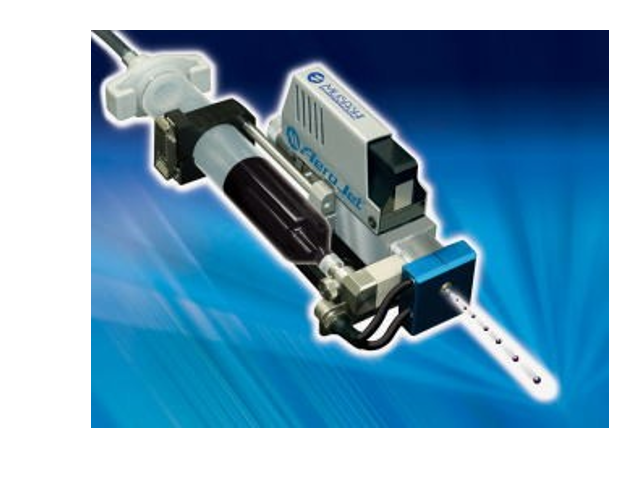
Non-contact jet dispensers use a jetting mechanism to shoot fluids from a distance on to the substrate so that the nozzle does not need to be in close contact with the surface of the product. Jet dispensing is performed by high-speed dot pulsations from the nozzle, therefore single dot dispensing as well as line dispensing by connecting these dots is possible.
Musashi Engineering is a global leader in fluid dispensing systems for automation, and their large selection of jet dispensers enables jetting for various materials with a wide range of viscosities.
Some benefits of jet dispensing are below:
- Faster cycle times due to elimination of z-axis adjustment
- Ability to dispense at any direction
- Enables dispensing in small cavities
- Part warping or part inconsistencies can be neglected
Watch this video showing some applications where the jet dispenser functionality
is most effective.