
Winding fibers to produce bobbins or fiber packages is a commonly needed intermediate process in many composite production processes. Winding can damage the filaments or can induce twist if not properly done. If possible, it would be preferred not to wind, but instead take the fibers directly to the final product.
However, composite manufacturing processes come in all shapes, speeds, and sizes, therefore integrating the composite manufacturing process with the actual fiber production process is impossible. Therefore, we are left with the task of winding the fiber to make it manageable in the next process.
When winding carbon fibers in particular, there are three main objectives:
1 – Good build of package
2 – No twist in the fiber
3 – Minimal damage of the filaments
The means of achieving these properties vary depending on the type of fiber and number of filaments. In many cases actual test winding is required, but our decades of experience serve as a starting point to set base parameters. Optimum winding parameters such as tension or wind ratios are difficult to determine without experience and our team of engineers can help you achieve the winding characteristic desired.
In this article, we would like to go over the different types of winders available and what applications they are the best fit for.
Take-Up Winders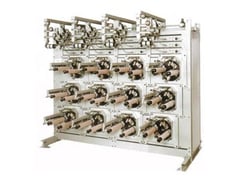
Take up winders are used for winding up fibers in a process. Primary applications would be for fiber production lines, tow-preg production lines, fiber coating lines, fiber spreading lines….etc.
A separate drive roller in the process must feed fiber to the take up winder. The winder then synchronizes with the drive roller speed and controls the winding tension of the fiber throughout its wind, which is crucial to producing the proper shape of the wound package.
The EKTW-C is the most popular winder for carbon fiber production and coated fiber processes. The EKTW-CA is an auto-doffing turret type for continuous automatic operation.
The EKTW-CLH is a high-speed version of the EKTW-C series winder, and is used for fibers with higher speed production rates such as aramids and other synthetic fibers.
The EKTL is for large package winding, for carbon fiber PAN precursor or tire cord applications.
Re-Winders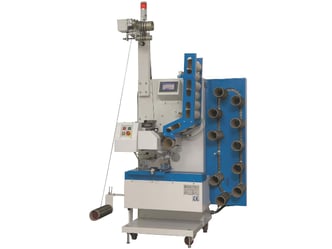
Re-winders are used to break down large packages into smaller ones or combine smaller packages into larger ones. Small packages of carbon fiber are typically not available from the fiber manufacturers, so these re-winders come in handy when trying to make several hundred packages for a creel as an example. They can also be used to combine short packages together to form a larger one.
EKTW-CL-FR – This is a manual rewinder equipped with a feed roller to handle rewinding of any high-performance fiber. It can be equipped with optional flat tow handling guides. The unit is equipped with a length counter to automatically stop at a preset length, ensuring all rewound packages are identical in length.
KTAW – This is a fully automatic rewinder. Once loaded with empty cores, it will automatically rewind packages to a preset length, cut fiber and doff, reload new cores unassisted. This winder is ideal for large volume rewinding applications. This unit can also be equipped with flat tow guides for heavy and flat tow rewinding.
Braiding Bobbin Winders
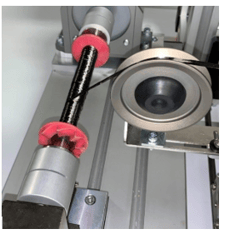 These winders are specifically made to wind braiding bobbins. Typically, these winders are not made specifically for carbon fiber, and cause too much abrasion to the fiber or induce too much twist. This results in fiber breaks during the braiding process, or too much damage to the fiber during the braiding process.
The BBW-6-100 braiding bobbin winder is made specifically to produce carbon fiber braiding bobbins from standard carbon fiber packages. The winder setup ensures the fiber is not twisted from let off creel to the rewound bobbin, and utilizes rotating contacts from start to end to prevent filament breakage during the fiber path.
Tape Winders
When winding slit tapes, in many cases they are wound onto a narrow reel the width of the tape to prevent damaging the product. However, this results in a small amount of material being wound on the reel and subsequently decreasing efficiency in the following process. Traversing the material with a guide can put more material on the package, but can result in distortion, bending, or wrinkles in the product. winding. The EFT bobbin traverse winder can solve these problems and wind flat materials onto the bobbin. It traverses the bobbin assembly instead of the tape itself.
If the tape material is coated with epoxy or other sticky substance, then it may be required to have a release liner sandwiching the tape to prevent sticking to the top and bottom layers. In this case the EMFT-BT-EF-R is recommended, as it provides a release liner payoff and winding system to apply the liner when winding this type of tape.
Tabletop Winders
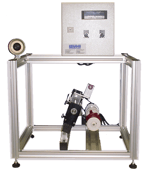 For laboratory use an industrial style floor standing winder may be too bulky and large, and smaller tabletop winder could be the better fit. The TTW winders are an alternative to the industrial style winders.
These tabletop winders still incorporate features which enable winding without damage or twist to the carbon fiber, and can be used for other high-performance fibers.
There are a few types to choose from depending on the application: constant torque control, constant tension control, constant speed control, and constant rpm control.
Parallel Winders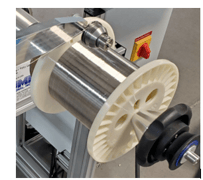
For wire, fiberoptics, and other round materials parallel winders are used to accurately lay the material side by side in a preset pitch. Parallel winders require a flanged bobbin to prevent the material from falling off of the edges.
These winders incorporate a servo driven bobbin traverse with a servo driven winder drive to electronically gear the two together, to enable fine pitch control. This winding method maximizes the amount of material wound on a reel and also optimizes the payoff of the material for the next process.